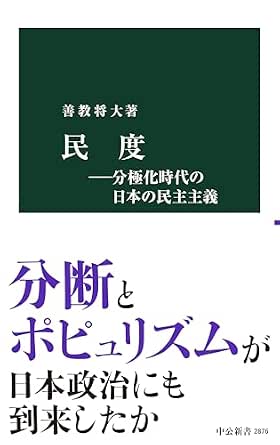
Masahiro Zenkyo (born 1982) is a political scientist specializing in political behavior, public opinion, and survey methodology. He studied policy science at Ritsumeikan University, earned a master’s degree at Doshisha University, and received his doctorate from Ritsumeikan in 2011. After working at local-government research institutions, the Hyogo Earthquake Memorial 21st Century Research Institute, and Tohoku University, he joined Kwansei Gakuin University, becoming a professor in its School of Law and Politics in 2021. His research uses surveys, survey experiments, and field experiments to examine political trust, turnout, and party support. His doctoral research developed into Nihon ni Okeru Seiji e no Shinrai to Fushin. Ishin Shiji no Bunseki (2018) then investigated support for Osaka’s Japan Innovation Party from voters’ perspectives, questioning accounts that treated its supporters as simply irrational followers of populism. The book received the Suntory Prize for Social Sciences and Humanities in 2019. Mindo (2025) examined Japan’s changing democracy through evidence on electoral participation, partisanship, young voters, and the influence of mass media and social media.