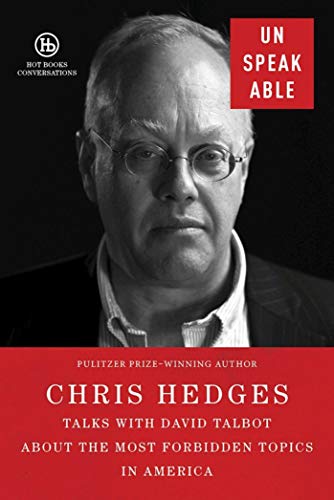
Chris Hedges (1956–) is an American journalist, nonfiction writer, and longtime war correspondent. He studied English literature at Colgate University and earned a Master of Divinity degree from Harvard Divinity School. After working for The Christian Science Monitor, National Public Radio, and The Dallas Morning News, he joined The New York Times in 1990 and served as the paper’s Middle East and Balkan bureau chief.
He reported from conflicts including the Gulf War and the wars in the former Yugoslavia, as well as from the Middle East. In 2002, he was part of the New York Times reporting team that received the Pulitzer Prize for Explanatory Reporting for its coverage of global terrorism. In “War Is a Force That Gives Us Meaning,” published in Japan as “The Seduction of War” (『戦争の甘い誘惑』), he examines how war can give people a sense of community and purpose while drawing them into violence and destruction. In “American Fascists: The Christian Right and the War on America” and “Empire of Illusion: The End of Literacy and the Triumph of Spectacle,” he critically explores the effects of the religious right, capitalism, the media, and mass culture on democracy. His writing continues to examine war, poverty, political repression, and social collapse through the experiences of people living at the front lines of history.
Himes, Andrew (著)、Bentham, Rachel (著)、Hedges, Chris (著)、Shay, Jonathan (著)、Turner, Brian (著)、Warn, Emily (著)、Wilber, Alix (著)、Antoon, Sinoon (著)、Stallworthy, John (著)、Abani, Chris (序論)